Contacts

Bird Rock, St Kitts, St Kitts and Nevis, West Indies

info@lakehealthandwellbeing.com

+1 869 765 8702

Research for Macmillan Cancer Support
CancerNews

Research for Macmillan Cancer Support

OPM, an independent research organisation, has been commissioned by Macmillan Cancer Support to conduct research on patients’ experiences of care transitions on their cancer journey. They are running a survey as part of this research.

By care transitions they mean a change in the place, provider or goal of the care that a person living with cancer is receiving. These changes occur at different stages of the journey, such as around diagnosis, and when treatment stops and someone enters recovery, or palliative care.They are interested in how people experience transitions, what factors influence these experiences and what impact this has.

OPM would really appreciate it if you could take 20 minutes to fill in the survey, by Wednesday 4th March 2015.

The online survey can be completed at:

LINK: http://www.snapsurveys.com/swh/surveylogin.asp?k=142072251407

If you would prefer a paper copy of the survey, please email or call Ellie Mendez Sayer with your address and she will send you a copy and a pre-paid return envelope.

Please also forward the link to anyone you know who might be interested in completing this survey.

If you have any further questions about this research, please do not hesitate to contact Ellie Mendez Sayer on 02072397818 or emsayer@opm.co.uk

Writing as Therapy
Mental Health

Writing as Therapy

On Saturday 7th February, we attended an excellent and very moving book talk and reading by the author of Let’s Talk About Love (and pain). This was a very honest conversation with an extremely talented and fearless writer which really got us thinking about the effectiveness of writing as therapy.

Author, KLove, has written two books of poetry – Let’s Talk About Love (and pain) and Let’s Talk About Love (and pain 2). These are two books inspired by the author’s childhood challenges, battles with eating disorders and the difficulties of managing complex relationships. KLove describes not having an outlet to express her feelings and being quite insular and introverted meaning that she bottled every emotion and feeling up. Then she discovered writing. KLove described writing as her therapy, an excellent opportunity to explore her feelings without judgement and to personally address her past, present and future in a way that worked for her. Mainstream counselling proved to be unhelpful, but writing seemed to be the liberating, healing therapy that she needed.

This really got us thinking about writing as a way to heal our community. From our experience the African Caribbean community shies away from mainstream therapy which usually involves talk therapy and for more serious conditions drug treatment. We know that there are many people who are going through very difficult life challenges on their own.  Our culture has conditioned us to almost ignore our problems and just soldier on, be tough and keep going. This means many people go through life with unresolved issues and  not dealing with these issues is a problem that can have serious consequences on our mental health.

It’s important for the healing process to address the events that affect our emotions and not ignore them. This is particularly important when we encounter death, serious illnesses, heartbreak, abuse, job loss, etc. Dealing constructively with each problem we face strengthens us, heals us and teaches us. It releases us from the negativity and speeds up the healing process.  Using writing to delve into some of the emotions we are experiencing can be an effective form of therapy helping us analyse a situation and come to terms with it.

Dr Adrian Furnham a professor of psychology at University College London has said the following about writing as therapy:

“Over the past few decades the therapeutic power of writing has been discovered.  The task can require serious, introspection: an attempt to make sense of the past. To examine it from various angles rather than simply try to shift blame onto others. This is much more than simply trying to write pretty sentences. It is about singling out experiences, events and people that contributed to one’s life. Seeing cause and effect, understanding psychological processes can significantly increase self-understanding. Suddenly things become apparent: patterns observed, explanations obvious. Writing is also often redemptive. And it helps because nearly always it involves some commitment to change. Clearly writing does not work for all. But it’s amazingly cheap and effective”

The Mental Health Foundation has found that in the UK  black and minority groups are more likely to be diagnosed with a mental health condition; are more likely to experience a poor outcome following mainstream treatment; and sadly are more likely to disengage from mainstream mental health services, leading to social exclusion and a deterioration in their mental health.  With this in mind we need to find therapies that are effective for our community and writing therapy may be a good option that allows us to deal with our emotions before they deteriorate.

An article, Emotional and physical health benefits of expressive writing  written by Karen Baikie and Kay Wilhelm states that:

“Writing about traumatic, stressful or emotional events has been found to result in improvements in both physical and psychological health.  In the expressive writing paradigm, participants are asked to write about such events for 15–20 minutes on 3–5 occasions. Those who do so generally have significantly better physical and psychological outcomes compared with those who write about neutral topics.”

The authors describe some of the theories as to why writing as therapy is effective: it is a  process of emotional catharsis or venting of negative emotions; it allows people to acknowledge emotions that they are actively suppressing. Suppressing emotions requires effort and acknowledging these emotions reduces the physiological work of suppressing emotions and gradually lowers the overall stress of the body; writing allows a coherent narrative of an event to be developed. This means that over time people can logically process an event by organising and structuring the memory, how they feel about it and learn how to manage their feelings; and repeated exposure to the negative emotional experience, through writing, may slowly cause those negative emotions to diminish.

Writing can be a powerful form of therapy and is worth exploring if you need an outlet for the emotions that you may be experiencing either from the day-to-day challenges of life or more serious traumatic experiences.  Try it and please do let us know what you think.

And, to find out more about KLove’s books you can visit Amazon

We’re Hosting a Prostate Cancer Session at Pneuma Christian Centre
CancerNews

We’re Hosting a Prostate Cancer Session at Pneuma Christian Centre

We’ll be hosting another Understanding Prostate Cancer session on 21st Feb 2015 at Pneuma Christian Centre. This event is a collaboration between The Lake Foundation, Punema Christian Centre and Prostate Cancer UK  and is a part of  the centre’s men’s conference which runs from 18th – 22nd Feb.

The  theme of the conference is Empowerment for a Healthy Life and our prostate cancer session will empower men with the information they need to take quick action should they notice any of the symptoms of prostate cancer.  Our session will cover: what is the prostate, prostate conditions, prostate cancer, signs & symptoms and risk factors.

All are welcome to attend. For more information please visit our events page or email us

Getting Fit With AfroFit
AfroFit PilotBlogPhysical Activity

Getting Fit With AfroFit

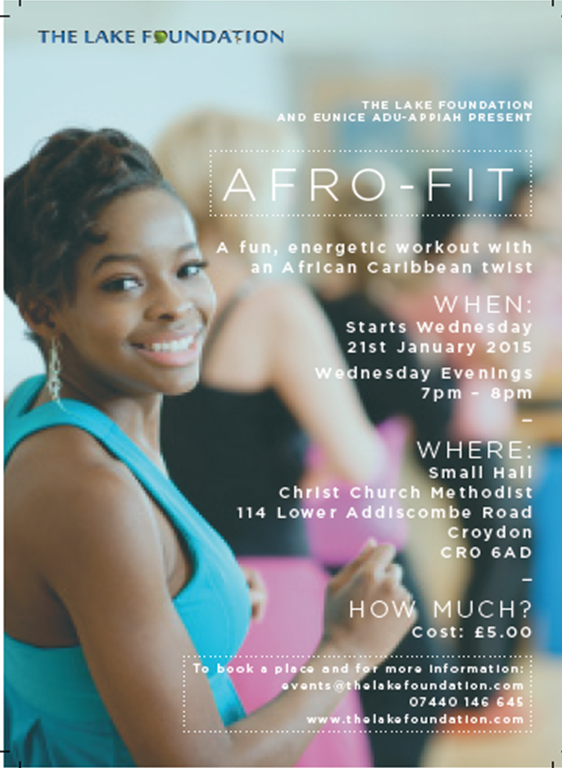
On Wednesday, we were back at Christ Church Methodist for another fun session of AfroFit. AfroFit is led by Eunice Adu-Appiah a health promotion professional with ten years of nursing experience. Eunice is extremely knowledgeable with years of experience in fitness training having been an athlete herself (sprinter) in university. She’s absolutely fantastic, explains everything and is really friendly and approachable.

Wednesday’s class was really fun with a slight variation to the previous week’s session. After our funky warm-up and stretch we did a selection of circuit training exercises to improve our mobility and strength. These exercises included plank, lunges across the room, spider lunges across the room and ab wheel roll outs. Once complete it was on to floor work and then our favourite part, cool down and relaxation – yay!

This was another great class by Eunice. The circuit training made it very challenging but with the great music and Eunice’s passion we were motivated to keep going.

We’ll be back at Christ Church Methodist next Wed at 7pm. Please do join us in our drive to get our community fit and healthy.

For more information and directions click here.

A meat-based diet leads to ill health
BlogDiet

A meat-based diet leads to ill health

Today’s blog post comes from Orvel Douglas a Nutrition and Diet Specialist at Body Sculpt of New York. This post follows Orvel’s previous post, A Plant-Based Diet Will Give You Optimum Health.

Mr Douglas is a Certified Nutrition and Diet Specialist in the United States where he has worked as an independent nutrition consultant for various organizations and companies. He has provided nutrition counseling and workshops for the following organizations: Medgar Evers College Empowering Youth to Excel and Succeed Project (“EYES”); United Federation of Teachers; DC 37 and 1199 SEIU.  Mr. Douglas is currently providing nutrition workshops for the Office of Alcoholism and Substance Abuse Services (OASAS) for their Access to Recovery Program (ATR) in Brooklyn, New York.  Mr. Douglas is also the Lead Nutritionist for Body Sculpt of New York’s Six Weeks to Fitness programs.


BodysculptlogoIn last month’s blog I encouraged everyone to think about adopting a plant-based diet and highlighted some of the benefits of such a diet.  Many studies have shown that animal proteins are causing many preventable diseases. What I have found is that when a person removes all animal protein from their diet many ailments tend to disappear.  The Physicians Committee For Responsible Medicine have been doing a lot of work in this area with the sole purpose of refocusing our efforts on prevention over pills. In this blog I wanted to take the time to summarize some of their work on identifying some of the dangers of a diet high in meat.

Meat-Eating is a Risk Factor for Developing Diabetes

Red_meat

February 21, 2014- Doctors should consider meat-eating to be a risk factor for developing type 2 diabetes, according to an article published in the journal Nutrients. Researchers from the Physicians Committee evaluated studies that examined different levels and types of meat consumption and the risk for developing diabetes. Meat-eaters had significantly higher risk of developing diabetes, compared with people who avoided meat. Meat’s effect on diabetes risk appears to be due to its content of saturated fat and haeme iron, among other factors. The authors recommend that consumption of meat products should be part of any screening for a patient’s risk for diabetes, alongside other established risk factors.

Animal Protein Linked to Early Death

March 4, 2014 – A diet high in animal protein leads to an earlier death, compared to a diet where less is consumed, according to a study analyzing data from 6,381 American adults aged 50 and older. Participants who ate the most animal protein had a 5-fold increase risk of death related to diabetes. Those younger than 65 who ate the most animal protein had a 74 percent increase risk for death from any cause and a 4-fold increase in death related to cancer, during a follow-up of 18 years. Risks for death were diminished or absent when protein sources were plant-derived.

Cholesterol Levels Lower in Vegans

February 10, 2014 – Those who consume vegan diets have better cholesterol levels than people who eat meat, fish, dairy, and/or egg products, according to a study published this month in the European Journal of Clinical Nutrition. Researchers examined data and blood samples from 1,694 participants from the European Prospective Investigation into Cancer and Nutrition-Oxford (EPIC) study. Participants were categorized as meat-eaters, fish-eaters, vegetarians, and vegans. Those who ate a vegan diet consumed the most fiber, the least total fat and saturated fat, and had the healthiest body weight and cholesterol levels, of all the diet groups.A previous analysisfrom the EPIC study found that vegan and vegetarian groups had a 32 percent lower risk of hospitalization or death from heart disease.

The Physicians Committee For Responsible Medicine’s Stance on Meat

PCRM promotes a vegetarian or vegan diet, together with aerobic and weight-bearing exercises and exposure to sufficient sunlight for vitamin D production. It writes that vegetarian diets are low in saturated fat, high in dietary fiber, contain phytochemicals that PCRM argues help prevent cancer, and contain no cholesterol. Its website cites several studies that it says show that vegetarians are less likely than meat eaters to develop cancer. It argues that a vegetarian diet can help prevent heart disease, lower blood pressure, can prevent and may reverse diabetes, and that it may improve the symptoms of a number of other conditions.[6] PCRM runs the Cancer Project, which suggests a vegan diet will help with cancer prevention, and that offers nutritional assistance to cancer patients.[7]

PCRM argues for the health benefits of avoiding dairy products—Barnard has called cheese “dairy crack”[8]—and campaigns for vegetarian meals in schools.[9] It also runs a website that collects reports of adverse health effects experienced by people on the Atkins diet. The New York Times writes that it was PCRM who in 2004 passed Dr Robert Atkins‘s medical report to the Wall Street Journal. The report, obtained by Dr. Richard Fleming of the Fleming Heart and Health Institute, showed that Atkins himself had experienced heart attack, congestive heart failure, and weight problems. Atkins supporters countered that there was no reason to think that his heart problem (cardiomyopathy) was diet related, and that his weight at death was higher due to fluids pumped into him in the hospital.[10]

The organization’s founder, Neal Barnard, M.D., has published dozens of peer-reviewed papers on nutrition in journals such asThe American Journal of Cardiology, The Lancet Oncology, and the Journal of the American Dietetic Association.[11] Naturewrote in 2006 that PCRM had become “an endless source of vexation for federal nutrition-policymakers,” but that Barnard’s position had some support within the medical community. William Roberts, a PCRM adviser, executive director of the Baylor Cardiovascular Institute, and editor of the American Journal of Cardiology said of Barnard. “He’s a superb man. Anybody who devotes their life like he has done to getting us all on the right dietary track, I admire.”

There is mounting evidence that turning awary from a meat-based diet is the best option for us and will significantly improve our health and wellbeing. We encourage everyone to take a look at their diet and cut out meat where they can, your health depends on it.

World Cancer Day 2015
CancerNews

World Cancer Day 2015

World Cancer Day takes place every year on 4 February and is the single initiative under which the Union for International Cancer Control (UICC), its members, partners and the entire world can unite together in the fight against the global cancer epidemic.

Under the tagline ‘Not beyond us’, World Cancer Day 2015 will take a positive and proactive approach to the fight against cancer, highlighting that solutions do exist across the continuum of cancer, and that they are within our reach.

The campaign explores how we can implement what we already know in the areas of prevention, early detection, treatment and care, and in turn, open up to the exciting prospect that we can impact the global cancer burden – for the better.

World Cancer Day 2015 will be articulated around four key areas of focus:

  • Choosing healthy lives
  • Delivering early detection
  • Achieving treatment for all
  • Maximising quality of life

For more information on how to get involved, please visit: www.worldcancerday.org


This article was written by the World Cancer Day team.

Getting AfroFit
AfroFit PilotBlogPhysical Activity

Getting AfroFit

Last night was the second session of our new aerobics class, AfroFit, which aims to give attendees a great workout whilst having a whole lot of fun.  The class is inspired by the Afro beats movement and thus the workout is choreographed to toe tapping Afro beats music.  It’s not all about fun though as there is some pain involved, but like our instructor says “no pain, no gain!”

AfroFit is led by Eunice Adu-Appiah a health promotion professional with ten years of nursing experience. Eunice is extremely knowledgeable with years of experience in fitness training having been an athlete herself (sprinter) in university. She’s absolutely fantastic, explains everything and has developed a really fun class that will appeal to everyone.

In last night’s session we worked every part of our body,  but it was so much fun that it really didn’t feel like a workout (well, some of it did, especially the floor work, ouch!). We started with a light warm up and then moved on to cardio which included some great African dance moves . This was followed by some floor work and then we finished with a cool down with some relaxation – ahh lovely.

This was a great session and is part of our drive to get our community fit and active. Please do join us next week at 7pm at Christ Church Methodist in Croydon. We’d love to see you.

For more information and directions click here.

Questions and Answers from our Fibroids Ask the Expert
BlogFibroidsWomen's Health

Questions and Answers from our Fibroids Ask the Expert

In October, we launched our Fibroids Ask the Expert, a resource that aims to provide anyone with a question or concern about fibroids with accurate reliable information from an expert in the field. Since its launch, we have received a number of really interesting questions which our experts have been delighted to answer. We thought it would be useful to share some of the questions and the answers with you.  So, this week’s blog is a fibroids Q&A.

Question: “How much are fibroids are likely to shrink after menopause?”

Answer:  “Fibroids may shrink after menopause, but not always.  There have been reports of fibroids shrinking by 50% after menopause and that symptoms improve or disappear completely after menopause.  This isn’t an instant process though and our understanding is that if shrinkage occurs it is usually gradual.”


Question: “My sister was diagnosed with fibroids one being 11cm, is that large?”

Answer: “A fibroid of 11cm is on the large side. Fibroids can vary in size from as small as a coin (about 2cm) to as large as a watermelon (about 19cm).”


Question: “Would Doctors consider the use of proteolytic enzymes as a part of the fibroid shrinking protocol?”

Answer:  “Proteolytic enzymes have the potential to “shrink” fibroids, however, to answer your question, a doctor’s protocol is relative to his/her academic training.  If the physician has been trained in biomedical sciences, he/she are less likely to promote this approach, unless perhaps to assist in decreasing the fibroid size prior to surgical intervention.  Nonetheless, there have been no major studies conducted that support a significant impact between proteolytic enzymes and fibroid shrinkage.  This is just another reason medical doctors may be less likely to support this protocol.  Naturopathic or homoeopathic doctors would be more inclined to consider proteolytic enzymes in addition to other forms of treatment to address fibroids, however, this decision needs to be made in consultation with your selected physician.”


Those are just a selection of some of the questions we have received. If you have a question about fibroids, no matter what, please do submit it  here or email us

Lack of Exercise Responsible for Twice as Many Deaths as Obesity
NewsObesityPhysical Activity

Lack of Exercise Responsible for Twice as Many Deaths as Obesity

A brisk 20 minute walk each day could be enough to reduce an individual’s risk of early death, according to new research. The study of over 334,000 European men and women found that twice as many deaths may be attributable to lack of physical activity compared with the number of deaths attributable to obesity, but that just a modest increase in physical activity could have significant health benefits. – See more at http://www.cam.ac.uk/research/news/lack-of-exercise-responsible-for-twice-as-many-deaths-as-obesity#sthash.hSDv1MLp.dpuf

Physical inactivity has been consistently associated with an increased risk of early death, as well as being associated with a greater risk of diseases such as heart disease and cancer. Although it may also contribute to an increased body mass index (BMI) and obesity, the association with early death is independent of an individual’s BMI.

To measure the link between physical inactivity and premature death, and its interaction with obesity, researchers analysed data from 334,161 men and women across Europe participating in the European Prospective Investigation into Cancer and Nutrition (EPIC) Study. Between 1992 and 2000, the researchers measured height, weight and waist circumference, and used self-assessment to measure levels of physical activity. The participants were then followed up over 12 years, during which 21,438 participants died. The results are published today in the American Journal of Clinical Exercise.

The researchers found that the greatest reduction in risk of premature death occurred in the comparison between inactive and moderately inactive groups, judged by combining activity at work with recreational activity; just under a quarter (22.7%) of participants were categorised as inactive, reporting no recreational activity in combination with a sedentary occupation. The authors estimate that doing exercise equivalent to just a 20-minute brisk walk each day – burning between 90 and 110 kcal (‘calories’) – would take an individual from the inactive to the moderately inactive group and reduce their risk of premature death by between 16-30%. The impact was greatest amongst normal weight individuals, but even those with higher BMI saw a benefit.

Using the most recent available data on deaths in Europe the researchers estimate that 337,000 of the 9.2 million deaths amongst European men and women were attributable to obesity (classed as a BMI greater than 30): however, double this number of deaths (676,000) could be attributed to physical inactivity.

Professor Ulf Ekelund from the Medical Research Council (MRC) Epidemiology Unit at the University of Cambridge, who led the study, says: “This is a simple message: just a small amount of physical activity each day could have substantial health benefits for people who are physically inactive. Although we found that just 20 minutes would make a difference, we should really be looking to do more than this – physical activity has many proven health benefits and should be an important part of our daily life.”

Professor Nick Wareham, Director of the MRC Unit, adds: “Helping people to lose weight can be a real challenge, and whilst we should continue to aim at reducing population levels of obesity, public health interventions that encourage people to make small but achievable changes in physical activity can have significant health benefits and may be easier to achieve and maintain.”

Reference

Ekelund, U et al. Activity and all-cause mortality across levels of overall and abdominal adiposity in European men and women: the European Prospective Investigation into Cancer and Nutrition Study (EPIC). American Journal of Clinical Nutrition; 14 Jan 2015


This article was written by Cambridge University and was first published on 14th January 2015 here. We have used this content as stipulated by its Creative Commons Licence.

Bad Luck, or Bad Medicine
BlogCancer

Bad Luck, or Bad Medicine

This week’s guest blog post comes from Sydney Ross Singer, Medical Anthropologist and Director of the Institute for the Study of Culturogenic Disease. Sydney discusses the recent media headlines that reported that two-thirds of cancers are a result of “bad luck”.

When a single medical study is trumpeted around the world as “truth”, you can be sure you are dealing with marketing and not medicine.

A recent study announcing that two-thirds of all cancers are just a matter of “bad luck” has made its marketing rounds, with the conclusion that all we can do to deal with our rogue mutated cells is to go to the doctor for early detection and treatment. (Variation in cancer risk among tissues can be explained by the number of stem cell divisions, Science 2 January 2015: Vol. 347 no. 6217 pp. 78-81).

Of course, this is good for the cancer detection and treatment industry. If cancer is out of our control, unrelated to lifestyle and genetics but merely a chance event, then you need repeated and thorough cancer screening throughout your life.

You can see why this one study has been embraced by media worldwide. Media, after all, is about selling products and services, just as the Internet is paid for by ads. Here they are selling cancer services.

However, if you step back from the hype, you can see a clear flaw in the conclusion of this study.

Essentially, the study asserts that tissues with higher rates of stem cell activity have higher rates of random mutations. Stem cells are the progenitor cells of the tissues. Tissues that have higher rates of turnover than other tissues have more frequent stem cell divisions which increase the likelihood of more cellular reproduction errors.

Some of these errors can cause the cells to reproduce excessively, resulting in tumour development and cancer. This sounds reasonable on the surface. However, it ignores part of the equation.

The body has a mechanism responsible for managing cellular mutations and killing these rogue cells. That part is the immune system.

Cancer cells are not normal, healthy cells, and the immune system recognizes these cells as defective and attacks and destroys them. This happens all the time, except when there is some immune system problem that allows these defective cells to continue reproducing. At that point, the mutated cells reproduce and grow, resulting in cancer.

This means that random mutations may cause a stem cell to go rogue. But a poorly responding defense system allows that rogue cell to develop further into cancer.

If we had no immune system mechanism for fighting mutated cells, then you would expect that there would be a direct correlation between stem cell reproductive rates, mutation rates, and the ultimate development of cancers.

However, if we had a perfectly operating and robust immune defence system, where every mutated cell was destroyed, you would expect that mutated stem cells would be killed before they could develop into cancers. There would then be no correlation between stem cell division rates and cancer incidence in those tissues. In fact, there would be no cancer at all.

In other words, stem cell random mutations don’t cause cancer. Immune system dysfunction causes cancer.

While the study did not look at breast tissue, we can see this role of the immune system in the development of breast cancer. It has to do with impairment of a central component of the immune system, called the lymphatic system.

The immune system consists of cells which fight disease and infection, the organs which produce and activate these fighting cells, and a lymphatic system through which these cells travel throughout the tissues. A problem with any aspect of the immune system can result in a reduced resistance against disease, including cancer.

When it comes to breast cancer, the immune system is impaired by constriction of the lymphatic system caused by the cultural habit of wearing tight bras for long periods of time every day. The lymphatic system consists of extremely thin tubules which passively drain lymph from tissues. These are easily compressed by the pressure of a bra.

Compression from the bra is apparent by the red marks and indentations in the skin. This pressure result is chronic fluid accumulation in the breasts, as the lymph fluid that bathes the cells is prevented from properly flushing out of the breast. This increases the toxin load in the tissue, reduces oxygen availability, impairs tissue repair and maintenance, and increases stem cell mutation rates.

Constriction of the breasts also reduces the ability of immune cells to fight infections and cancers within the tissue. White blood cells cannot function properly in stagnant, low oxygenated, congested, and toxic tissue.

Numerous studies have confirmed the link between breast cancer and wearing bras. In fact, it has been shown that bra-free women have about the same incidence of breast cancer as men, and the longer and tighter the bra is worn the higher the incidence rises, increasing over 100 times for 24/7 bra users compared to bra-free women. (Seehttp://www.killerculture.com/breast-cancer-is-preventable/)

Unfortunately, this information does not create a market for products and services. Indeed, it challenges the multi-billion dollar lingerie industry, as well as the cancer detection and treatment industry.

In a world where media exists to sell products and services, information that challenges the sales of products or services is ignored. Hence, news about the bra-cancer link has been suppressed and censored for the past 20 years. If the goal of media was to improve the human condition, the bra-cancer link would have been extensively publicized long ago.

But one study on the bra-cancer link was recently publicized worldwide, with similar fanfare as the “bad luck” cancer study. Not surprisingly, the study concluded there was no link. While the study admitted it was flawed by not including bra-free women, along with other problems, it was heralded as the final word on the issue. The conclusion, of course, was the typical sales pitch promoting early detection and treatment.

Of course, early detection and treatment of cancer mean you still get cancer. But when prevention is considered naive and futile, and cancers are considered just “bad luck”, there is nothing you can do but make an appointment for medical tests to see if you have cancer, and then treat it once you do.

Most cancers are not “bad luck”. They are bad immunity. If we are to discover the causes of various cancers, we must look at the reasons why the immune system is being compromised, allowing mutated cells to develop into cancer.

Of course, if any of these discoveries do not result in increased sales of a product or service, you will not hear about them. What you will hear about is any study, even if it is flawed, that concludes that you are helpless to prevent disease and that all you can do is rush to the doctor for early detection and treatment.

It’s not about health. It’s about money. That’s not bad luck, just bad medicine.


The Lake Foundation would like to thank Sydney Ross Singer for his guest blog piece which was first published on 7th January here. If you have any questions or comments please do leave them below in the comments section.