





Contacts

Bird Rock, St Kitts, St Kitts and Nevis, West Indies

info@lakehealthandwellbeing.com

+1 869 765 8702

Tag: stress management

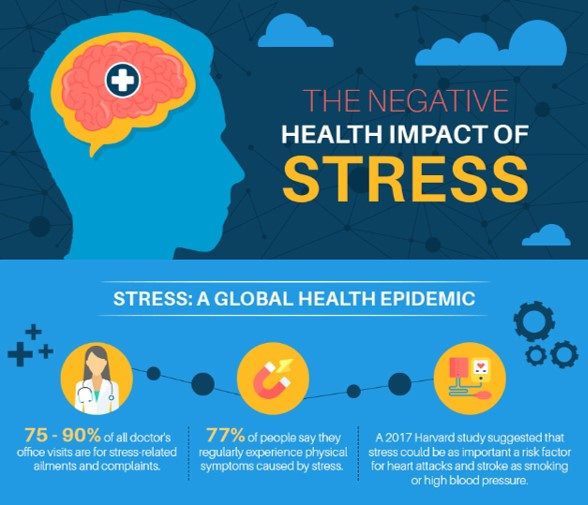
The Negative Impact Of Stress Infographic by SME
Blog

The Negative Impact Of Stress Infographic by SME

Today’s guest blog post comes from Aris Grigoriou,  Student Recruitment Manager at Study Medicine Europe (SME). Aris explores the negative impact of stress using  SME’s new infographic which provides a good overview of the science behind stress, how stress affects the body, the dangers of chronic stress and how we can all reduce the impact of stress.


Throughout the world, it’s safe to say that we’re all experiencing stress in some way, whether it’s due to financial challenges, health concerns or a demanding workload.

Currently, many people are either suffering from poor health or having difficulty minimising risk factors that cause illness or chronic conditions. We can’t argue with the data. Harvard Health Publishing reported that “the United States spends the most money on healthcare, and yet still has one of the lowest life expectancies of all developed nations.” In a nutshell, we need to pay attention to all the elements that impact on our health.

We can’t deny that stress is a huge barrier to our collective wellbeing even if paradoxically we’re able to practise good health habits elsewhere. In fact, the World Health Organization has declared stress the Health Epidemic of the 21st Century. The challenge with knowing how to identify and manage stress largely lies in the mythologies we have around it. Neuroendocrinologist and neuropharmacologist George Fink says, “Stress is a highly personalized phenomenon that varies between people depending on individual vulnerability and resilience and between different types of tasks.” Building upon this analysis, we need to remember that what promotes health is empowering data that encourages personal and social solutions to a unique problem.

Study Medicine Europe has published its ‘The Negative Impact of Stress’  infographic to help promote health and support people to learn more about this area of wellbeing. Not only is this graphic designed to provide explanations on the way stress affects the body, but it’s also deliberately been created to connect everyone with the straightforward information you might not get when you look for facts on this topic elsewhere. Above all, remember that health is considered to be multifaceted and there might be parts of your life that require attention even if you don’t think they’re related to stress. We hope this helps you in your pursuit of better physical, mental and emotional health.

About Study Medicine Europe

Study Medicine Europe is the leader in medical student recruitment with offices in the UK, USA and India. Having many years of experience in securing placements for prospective students from all over the world. More specifically, they officially represent and are affiliated with  Medical Schools in Europe (Armenia, Georgia, Ukraine, Serbia, Romania, Bulgaria) that offer English-language undergraduate and graduate programs in Medicine, Dentistry and Veterinary Medicine.  You can find out more about them here
Stress Management Through Emotional Intelligence
BlogMental Health

Stress Management Through Emotional Intelligence

Welcome back to our blog! Today, we’re delighted to have a guest blog submitted by Nina Johnson-Campbell of the NJC Therapy Practice.

Nina discusses how we can manage stress through emotional intelligence and provides some really useful tips that just require 10 minutes of your day. 

This is the second blog from Nina Johnson-Campbell, in her first blog Nina explored a new tool to support the wellbeing of children and adults. You can read her first post here


What Exactly is Stress?

Stress is a necessary, innate/natural part of our survival instinct and physiological make up; it motivates us to take action to keep us safe or to keep reaching just that bit further to achieve our dreams and aspirations; it’s the ‘fuel’ that propels us.

Stress only becomes a problem when the physiological and physical symptoms build up in our body without being released and as a result starts to negatively impact our: memory, concentration, emotions, thinking abilities, health, our overall wellbeing and eventually our mental health.

What is Emotional Intelligence(EI*)?

EI is the ability to recognise and understand your emotions and those of others; the ability to use that information to guide your thoughts and actions; the ability to empathise (and therefore build better, successful relationships).

How can Emotional Intelligence (EI) help to manage stress effectively?

  • Helps you to reduce excess stress as you better understand your emotions (becoming more self-aware);
  • Use that information to guide your thoughts and actions;
  • Increase your empathy through better understanding of others’ emotions, which in turn
  • Improves your relationships, at school, at home, in the work place** and socially.
  • Improving your emotional intelligence will help you to discover your inner strengths, remain calmer and in control in any situation.

Start to improve your Emotional Intelligence right now, today, by doing this simple exercise:

Set aside just 10  mins.

  1. Think of the last time you had a strong negative feeling towards someone, it may be a friend, partner, work colleague or even a stranger.
  2. Name the exact emotion you were experiencing in that moment (maybe anger, resentment, frustration, disappointment etc)
  3. Next take a few moments to explore why you were feeling that emotion (for example you may have felt mistreated, undervalued, ignored, inadequate, unloved).
  4. Now consider how the other person may have felt in that moment too, could they have been experiencing similar emotions? How do you know for sure how or what they were really thinking?
  5. As you’re now aware, you cannot be sure without further information what they were feeling/thinking. In light of this new awareness,
  6. Consider how you could have responded in a better/constructive way for you.
  7. What did you learn from that situation, good or bad?
  8. What will you do differently next time?

As it’s your response and not the situation that determines your outcome, take time to pause and by practising the few simple steps outlined above, I guarantee you will start to see better results as you  reduce your stress by taking control of your emotions, instead of them controlling you and allow space for you to think more clearly.

Remember as Confucius said:

‘Mighty is the man who can command an army of thousands, Mightier still is the man who can command himself’.

If you would like to discover how managing stress through EI could improve other areas of your life, please contact me at: Johnsm2643@gmail.com or visit my website www.life-njctherapy.co.uk


Notes

*M. Beldoch c.1964

** Some studies have shown that job candidates with higher levels of EI are often more successful; perform better once employed; make great managers and business owners ( Forbes.com; Times on Sunday; Harvard Business School)

The above article was  published in  2016: http://jamaica-gleaner.com/article/health/20161116/stress-management-through-emotional-intelligence

Copyright N.Johnson-Campbell (2016)
